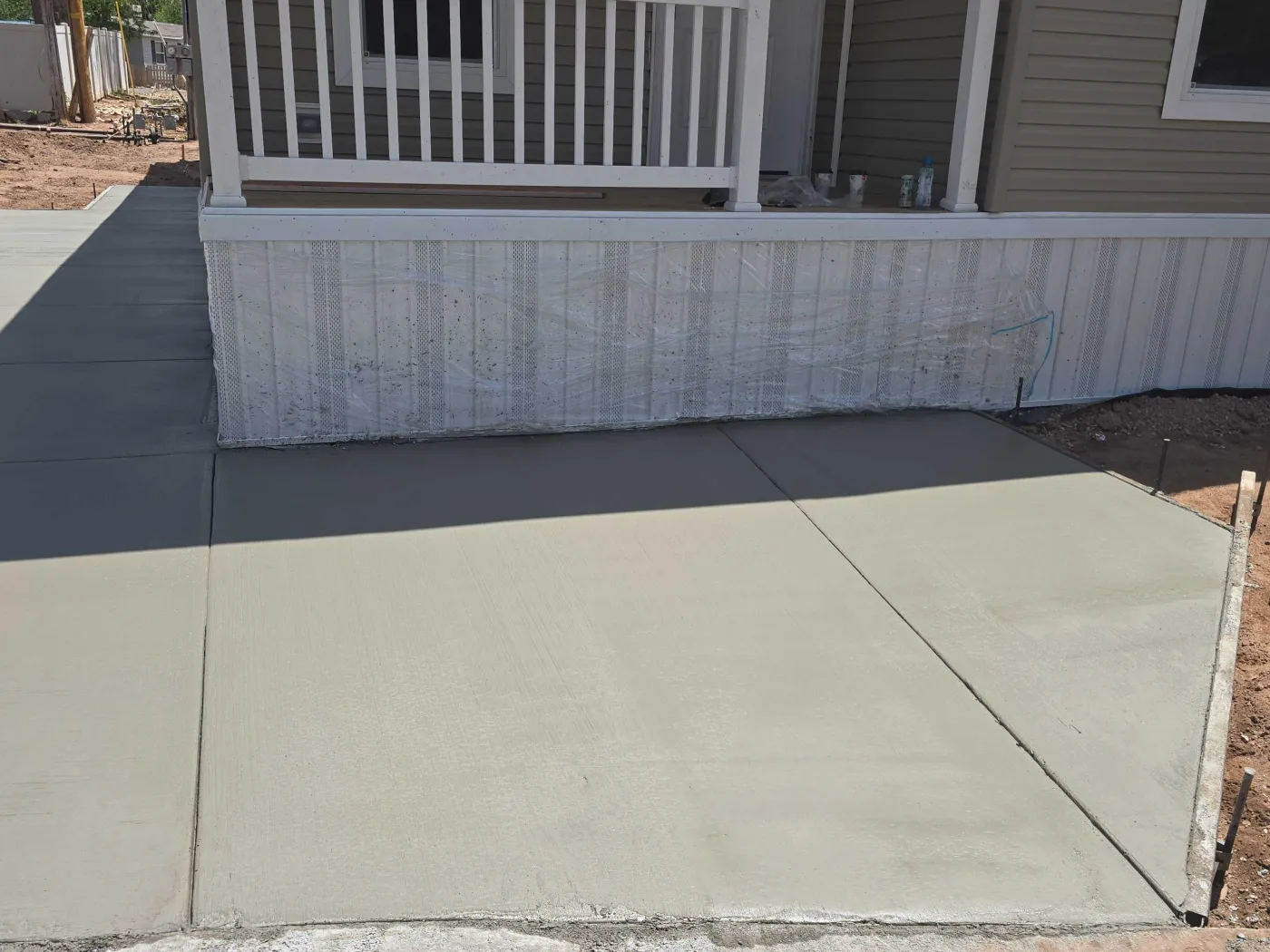
How much does a concrete slab cost in Billings, MT?
Published 2026 cost guides put a plain 4 inch concrete slab at about $6 to $12 per square foot installed, and a 6 inch reinforced slab for a garage or shop at roughly $8 to $14. At those rates a 24 by 24 garage floor lands between $4,600 and $8,000. Thickness, reinforcement and what is under the slab decide where you land.
Those are national market ranges, not our prices. A real number needs a look at the site, because access, soil and the frost rules the City of Billings enforces move the total more than any per-foot average. Ostermiller Construction pours garage slabs, shop floors, RV pads and shed pads across Billings, Laurel, Lockwood and the valley, and this guide covers what drives the quote.
What does a concrete slab cost per square foot?
A finished square foot of 4 inch slab costs around $6.50 to $7.50 at the 2026 national midpoint, and every part of it is a line item. Ready mix is only a quarter to a third of the bill. Base prep, forms, reinforcement and the crew that places and finishes the concrete make up the rest.
| Cost component | Typical 2026 range per sq ft | What it covers |
|---|---|---|
| Ready-mix concrete | $1.60 to $2.40 | 3,000 psi mix delivered, short-load fee on small pours |
| Gravel base and prep | $1.00 to $2.00 | Excavation, 4 to 6 inches of crushed stone, compaction |
| Forms and reinforcement | $1.00 to $1.50 | Form boards, wire mesh or rebar, chairs, joints |
| Placing and finishing | $2.00 to $3.00 | Crew, screed, bull float, broom finish, control joints |
| Curing and cleanup | $0.40 to $1.10 | Curing compound, cold-weather cover, site restoration |
Those component ranges come from a 2026 national cost guide. Montana ready mix runs a little above the national midpoint. One Montana supplier’s public 2025 price list shows 3,000 psi concrete at $190 a yard, 3,500 psi at $196 and 4,000 psi at $202, with fiber at $9 a yard, winter heating at $9 a yard and a surcharge on loads under four yards. A modeled 2026 figure for the Billings market is about $170 a yard. A 24 by 24 slab at 6 inches takes about 10.7 yards, so the concrete alone runs roughly $1,800 to $2,200 before anyone sets a form.
What do common slab sizes cost?
A 20 by 20 slab runs about $2,400 to $4,800 at 4 inches and $3,200 to $5,600 at 6 inches, using the published per-foot ranges. Small pads cost far more per square foot than big ones because the crew, the truck and the minimum load show up either way.
| Slab size | Square feet | 4 inch at $6 to $12 per sq ft | 6 inch reinforced at $8 to $14 per sq ft | Typical use |
|---|---|---|---|---|
| 10 x 10 | 100 | $600 to $1,200, often more | $800 to $1,400, often more | Shed pad, hot tub pad |
| 12 x 12 | 144 | $860 to $1,730 | $1,150 to $2,020 | Shed, small patio |
| 20 x 20 | 400 | $2,400 to $4,800 | $3,200 to $5,600 | Tight two-car garage |
| 24 x 24 | 576 | $3,460 to $6,910 | $4,610 to $8,060 | Standard two-car garage |
| 30 x 30 | 900 | $5,400 to $10,800 | $7,200 to $12,600 | Three-car garage, small shop |
| 30 x 40 | 1,200 | $7,200 to $14,400 | $9,600 to $16,800 | Shop or pole barn floor |
| 40 x 60 | 2,400 | $14,400 to $28,800 | $19,200 to $33,600 | Large shop, equipment barn |
The small-pad caveat is real. One 2026 guide prices a complete 10 by 10 pad, base and rebar included, at $2,250 to $3,550, which is $23 to $36 per square foot. Mobilization, forms and the minimum load charge cost about the same for 100 square feet as for 1,000. If you are pouring a shed pad, budget on the total, not the per-foot rate. If a patio or walk is on the wish list too, pouring it in the same visit spreads those fixed costs.
How thick should the slab be?
Four inches is the working standard for pads that only carry foot traffic, and 6 inches with rebar is the standard for anything a vehicle parks on. The residential code sets the floor at 3.5 inches for a slab inside a building, and most contractors pour 4 to leave room for subgrade variation.
| Thickness | Best for | What changes |
|---|---|---|
| 4 inches | Shed pads, patios, walks, storage buildings | Wire mesh or fiber, the lowest cost |
| 5 inches | Single-car garages, light-duty parking pads | Rebar recommended |
| 6 inches | Two-car garages, shop floors, RV pads, trailer parking | #4 rebar grid, the residential vehicle standard |
| 8 inches and up | Vehicle lifts, heavy equipment, commercial floors | Engineered reinforcement |
Going from 4 to 6 inches uses 50 percent more concrete, which adds about $0.80 to $1.10 per square foot in material. With the rebar grid a 6 inch slab usually carries, the full premium over a 4 inch mesh slab runs closer to $2.50 to $3.50 per square foot. On a 24 by 24 garage that is roughly $1,400 to $2,000 more, and it is the difference between a floor that carries a loaded pickup for decades and one that cracks along the tire paths.
One warning from the shop-building side: thickness follows the heaviest thing that will ever sit on the floor, not the building above it. Steel and pole buildings carry their weight to the perimeter, where the slab edge gets thickened or footings go under the posts. Pouring the whole field at 6 inches for a light-duty shop spends money the middle of the floor never needed.
Rebar, wire mesh or fiber?
Rebar is the right answer for any slab that carries vehicles, and it costs $0.80 to $1.50 per square foot for a #4 grid on 18 inch centers. Wire mesh runs $0.35 to $0.80 and is fine for sheds and patios. Fiber mixed into the concrete adds $0.15 to $0.40 and controls surface cracking, but it is a supplement, not a replacement for steel.
Placement matters more than the steel itself. Reinforcement belongs in the middle of the slab, set on chairs, not lying on the gravel where it does nothing. Ask any contractor how the steel gets held up during the pour. Mesh that is meant to be pulled up mid-pour usually stays at the bottom.
Two more items belong on a garage or shop quote in this climate. The first is a vapor retarder: the 2021 residential code that Billings designs to calls for a 10 mil sheet under slabs inside a building, and exempts driveways, patios and unheated accessory buildings. Skip it under a heated shop and the floor sweats every spring. The second is air entrainment for any slab that lives outside. The ready-mix industry recommends 4,000 psi concrete with about 6 percent entrained air for exterior slabs exposed to freezing and deicers, and it costs a few dollars a yard.
What do Billings frost rules and permits change?
The City of Billings designs to the 2021 residential code with a 42 inch frost depth for foundations, and that number is the line between a pad and a foundation. A slab that carries a building wall needs footings or a thickened edge that reach frost depth. A pad that carries only a parked truck does not. The first is a foundation job and prices like one.
Permits split the same way. The city’s own list says a building permit is required for almost any construction, parking lots included, while sidewalks and driveways that sit entirely on private property and do not support a structure are exempt. Detached sheds up to 200 square feet need no permit. A detached garage or a shop over that size needs a New Accessory Structure permit, and residential zones cap detached buildings by lot size: up to 1,000 square feet on lots under a quarter acre, up to 1,500 on lots over an acre, and never more than the house’s first-story footprint.
Outside the city limits the rules change again. Yellowstone County does not issue building permits at all, and the State of Montana’s Building Codes Bureau governs the unincorporated areas. If the shop pad is going in at Shepherd, Lockwood or out in the Huntley Project, a call to the state office at 406-841-2056 before the pour is worth the ten minutes. Rules move with each code cycle, so confirm the current requirement with the city or the state before you order concrete.
When can a slab be poured in Montana?
Late spring through early fall is the pouring season, and the calendar fills front to back. Montana DOT defines cold weather concreting as any time the forecast calls for air below 35 degrees during the curing period, and it does not allow concrete placed on frozen base or subgrade. Shoulder-season pours happen with heated water and insulated blankets, which is why the supplier price sheet lists winter heat as a $9 per yard add-on.
The base is where Montana pours succeed or fail. Billings averages 81 freeze-thaw cycles a year in NOAA’s engineering weather data, and a slab on soft or wet ground follows that ground down. Compacted gravel base, grades that shed water away from the slab, and downspouts routed off the pad are cheap insurance against a pad that tips toward the door by its third winter.
How do you get a real number?
Measure the pad, decide what will park on it, and get a quote that itemizes thickness, reinforcement, base depth, psi and finish. A price with no breakdown is making assumptions you have not seen. Ostermiller Construction pours concrete slabs and pads for garages, shops, RVs and sheds across the Billings area, and the estimate is free and in person.
If the slab in question is a driveway, what a concrete driveway costs around Billings covers that math, and a failed pad that needs to come out first is a removal and replacement job. We do not lift or level settled slabs. The fix for a pad that has dropped is a rebuilt base and new concrete. Ask for a free estimate and we will put a number on your project.
FAQ
How much does a 20x20 concrete slab cost? At published 2026 rates a 20 by 20 slab, 400 square feet, runs about $2,400 to $4,800 at 4 inches and $3,200 to $5,600 at 6 inches with rebar. Guides that price the full package with base and vapor barrier land higher, around $4,650 to $8,250. Site prep and access set the final number.
What does a 24x24 garage slab cost? A 24 by 24 garage floor is 576 square feet. At the 6 inch reinforced spec a garage should have, published ranges put it around $4,600 to $8,100 installed. Add a vapor retarder if the garage is heated, and add footings to frost depth if the slab carries the building’s walls.
How much does a 30x40 shop slab cost? A 30 by 40 shop floor is 1,200 square feet and runs roughly $9,600 to $16,800 at 6 inches with rebar, using 2026 guide ranges. Large pours land at the low end per foot because the fixed costs spread out. Thickened edges or frost-depth footings for the building add to that.
How thick should a garage or shop slab be? Six inches with a #4 rebar grid is the residential standard for garage floors, shop pads and anything a truck or trailer parks on. Four inches is fine for sheds, patios and walks. The code minimum inside a building is 3.5 inches, and vehicle lifts or heavy equipment call for 8 inches with engineered steel.
Do I need a permit to pour a slab in Billings? Inside city limits, a slab for a detached shed up to 200 square feet needs no permit, and driveways or pads on private property that do not support a structure are exempt. A garage, shop or parking lot needs a city permit. Outside the city, Yellowstone County issues no building permits and the state Building Codes Bureau governs.
Is rebar worth it, or is wire mesh enough? Rebar is worth it on any slab that carries vehicles. A #4 grid on 18 inch centers adds about $0.80 to $1.50 per square foot and holds cracks tight for decades. Wire mesh at $0.35 to $0.80 suits sheds and patios. Fiber is an add-on for surface cracks, not a substitute for steel.
When can a concrete slab be poured in Montana? Late spring through early fall. Montana DOT treats forecasts below 35 degrees during curing as cold weather concreting and bars pours on frozen ground. Shoulder-season slabs use heated water and blankets at extra cost, and Billings sees about 81 freeze-thaw cycles a year, so the base and the timing matter.
Want a number for your own project?
We look at the job in person and hand you a free written quote across Billings & the Yellowstone Valley.