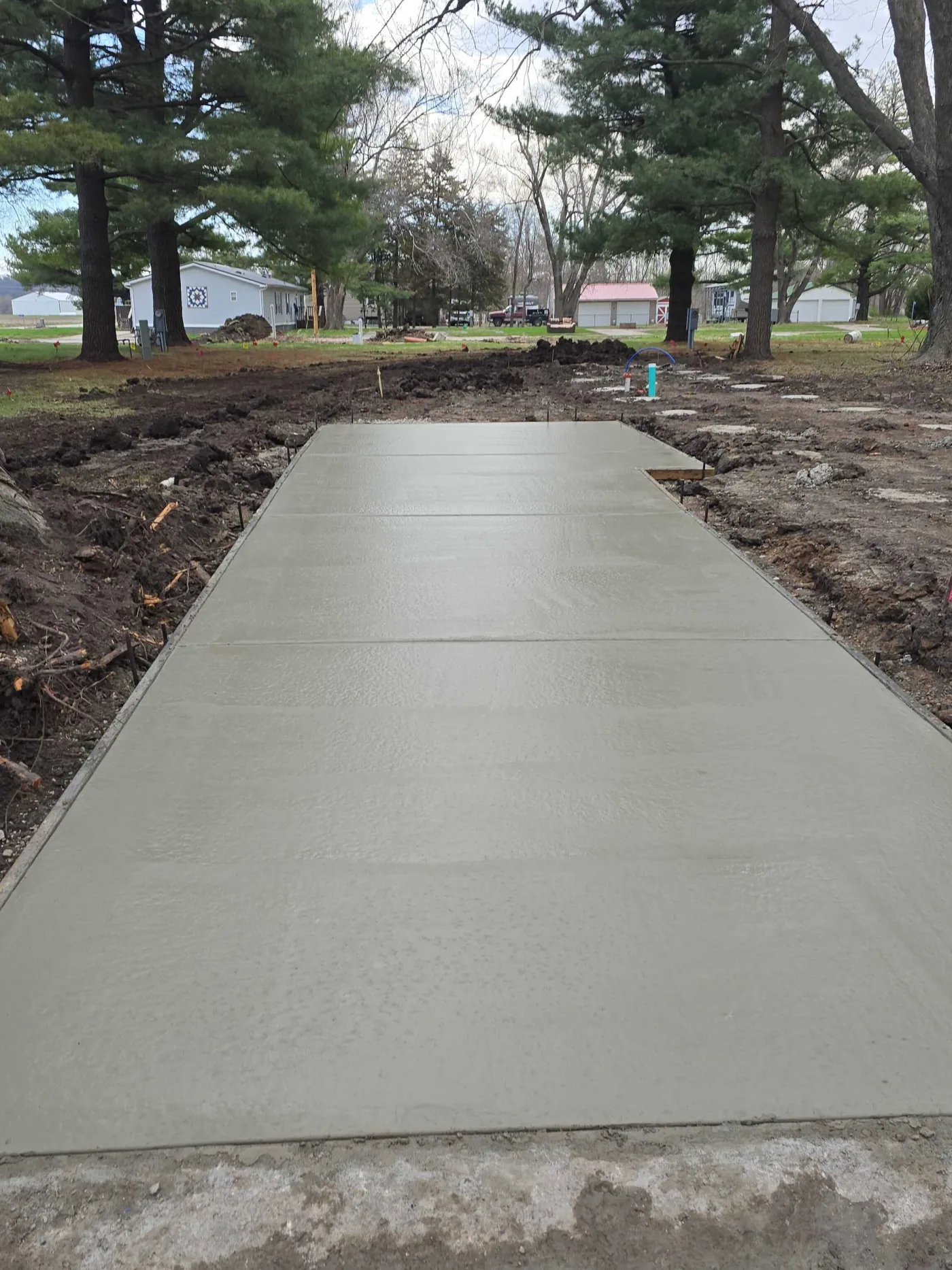
How much does a concrete driveway cost in Billings, MT?
Cost guides put a plain concrete driveway at roughly $8 to $12 per square foot installed in 2026. That works out to about $3,200 to $4,800 for a 20 by 20 two-car pad, and $4,800 to $7,200 for a 12 by 50 single-lane run. Tear-out, base repair and slab thickness move the number more than anything else.
Those are national ranges, not a quote. No cost guide publishes Billings-specific pricing for residential flatwork, so use them as a bracket and get a real number from someone who has looked at your ground. A new concrete driveway in Montana also carries a few costs that a driveway in a warm state does not.
What does concrete cost per square foot?
Plain gray flatwork runs about $6 to $8 per square foot for the concrete and finish work. Finished driveway jobs land higher, usually $8 to $12, because base prep, forms and site work sit on top of that rate. Decorative finishes climb from there.
| Finish | Cost per square foot |
|---|---|
| Plain gray, broom finished | $6–$8 |
| Colored, textured or exposed aggregate | $8–$12 |
| Stamped or imprinted | $12–$18 |
| Stained or saw-cut detail | $18–$20 |
Across all the major guides the full published spread runs from about $5 to $21 and up. Most driveways around Billings are plain gray with a broom finish, which is the cheap end of the list and also the right surface for a drive that gets plowed. A broom finish gives tires something to bite when the slab is wet or icy.
What does a driveway cost by size?
Multiply your square footage by $8 to $12 and you are close enough to budget with. Measure the actual concrete, not the yard. A driveway that looks small on paper often grows once you add the apron at the street and the turnaround by the garage.
| Driveway | Square feet | Typical installed range |
|---|---|---|
| Single, 12 by 20 | 240 | $1,900–$2,900 |
| Two-car pad, 20 by 20 | 400 | $3,200–$4,800 |
| Long single run, 12 by 50 | 600 | $4,800–$7,200 |
| Wide two-car, 24 by 32 | 768 | $6,100–$9,200 |
| Larger rural drive | 1,000 | $8,000–$12,000 |
Bigger pours cost less per square foot than small ones. The crew, the forms and the equipment show up either way, so a 200 square foot pad carries the same setup as a 1,000 square foot drive spread over a fifth of the concrete.
What do tear-out and base work add?
Removing an old slab adds roughly $1 to $4 per square foot, depending on how thick the concrete is and how close a truck can get. Reinforcement adds $1 to $3. Fixing soft ground under the slab runs around $2 per square foot. Those three items are where most quotes separate.
| Item | Typical added cost |
|---|---|
| Break out and haul off an old slab | $1–$4 per sq ft |
| Rebar or wire mesh | $1–$3 per sq ft |
| Extra base where the ground is soft | around $2 per sq ft |
| Apron at the street | $3–$10 per sq ft |
Thickness is the one adder people underestimate in the wrong direction. Going from four inches to six is 50 percent more concrete, but the forms, the crew and the finishing hours barely change. If a loaded truck, an RV or a stock trailer parks on the drive, the thicker slab is worth the small premium. The same thickness math runs through what a garage or shop slab costs in Billings.
Why does Montana change what gets poured?
Exterior concrete here gets ordered to a different spec than a garage floor. The national ready-mixed concrete association recommends 4,000 psi and about 6 percent entrained air for exterior slabs exposed to freezing and deicers. That air is what keeps the surface from flaking off.
Air entrainment puts millions of microscopic bubbles through the mix. When water in the concrete freezes and expands, it has somewhere to go instead of blowing the top layer apart. Concrete without it scales, which is the pitted, peeling surface you see on older drives all over the valley.
The other half is the base. Most driveway failures start under the slab, not in it. Soft or poorly compacted ground settles, water collects in the low spot, and the slab cracks along it. Regrading and compacting before the forms go up is unglamorous work that decides how the driveway looks in fifteen years.
Billings gives it plenty of chances to fail. NOAA’s engineering weather data for Billings Logan International Airport lists an average of 81 freeze-thaw cycles a year, counted over a 30 year record. Eighty-one times a year the temperature crosses freezing in one direction and then crosses back.
Is concrete cheaper in Billings than the national average?
Probably slightly, on the labor side. Construction cost index data puts concrete work in Billings below the national average, with the gap on labor rather than material. Cement and aggregate cost about what they cost anywhere. Crews cost less here than in a major metro.
That said, no consumer cost guide publishes verified Billings residential numbers, and anyone quoting you a firm price per square foot for your driveway over the phone is guessing. Site access, how much dirt has to move, and what is under the old slab are worth more than any regional multiplier.
When can a driveway be poured here?
The practical residential pouring season runs from late spring through early fall. Montana DOT defines cold weather concreting as any time the forecast calls for air temperatures below 35 degrees during the curing and protection period, and it does not allow concrete placed on frozen base or subgrade.
Shoulder-season pours happen, with insulated blankets holding curing temperatures up for the first week. They cost more and they need better weather luck. The short season is also why the calendar fills: everyone in Yellowstone County wants the same four months. Getting an estimate in early is worth more than shopping in July.
Repair, or replace the whole thing?
Small stable cracks in an otherwise sound slab usually are not worth spending money on. Once a driveway is cracked through, settled toward the garage, or losing its surface in sheets, patching becomes an annual expense. At that point tear-out and replacement is the cheaper line over any reasonable number of years.
Lifting a sunken slab is a separate trade, and it does not repair concrete that is cracked or flaking. We break out failed slabs, rebuild the base underneath, and pour new. If your driveway is on the edge, an in-person look will tell you which side of that line it sits on faster than any article will.
If you are weighing materials rather than contractors, our concrete versus asphalt comparison for Montana puts the two side by side on lifespan, maintenance and cost.
FAQ
How much does a concrete driveway cost in Billings, MT? Cost guides put plain concrete driveways at roughly $8 to $12 per square foot installed in 2026. A 20 by 20 two-car pad lands near $3,200 to $4,800. A 12 by 50 single-lane run is closer to $4,800 to $7,200. Tear-out and base repair sit on top of that.
How thick should a concrete driveway be in Montana? Four inches is the published minimum for cars and light trucks. Go to five or six inches if a loaded pickup, an RV or a stock trailer parks on it. The concrete volume goes up with thickness, but the labor barely changes, so the upgrade is cheaper than most people expect.
Does the old driveway have to come out first? If the slab is cracked through, heaved or flaking across the surface, yes. Breaking out and hauling off an old driveway adds about $1 to $4 per square foot depending on thickness and access. Pouring new concrete over a failed slab just moves the same problem up four inches.
When can concrete be poured in Billings? The practical residential season runs from late spring through early fall. Montana DOT calls it cold weather concreting once air temperatures are forecast below 35 degrees during curing, and it will not allow concrete placed on frozen ground. Shoulder-season pours are possible with blankets and protection.
Will a new concrete driveway crack? All concrete cracks eventually. Control joints decide where. Cut at spacings of about ten feet, with a joint down the middle of anything wider than twelve feet, the slab moves along the lines we give it instead of breaking across the middle where you would see it.
Is concrete cheaper than asphalt for a driveway? No. Published 2026 guides put asphalt at roughly $6 to $12 per square foot installed and concrete at $8 to $12 and up. Concrete costs more to install and lasts about twice as long, so the two flip depending on how long you plan to keep the place.
Get a number for your driveway
Square footage gets you a bracket. The rest comes from the site: what is under the old slab, how water moves across the lot, whether a truck can reach the back. Ostermiller Construction pours concrete driveways, patios, sidewalks and steps across Billings, Laurel, Lockwood and the Yellowstone Valley. Ask for a free estimate and we will measure your driveway and put a written price in your hands.
Want a number for your own project?
We look at the job in person and hand you a free written quote across Billings & the Yellowstone Valley.