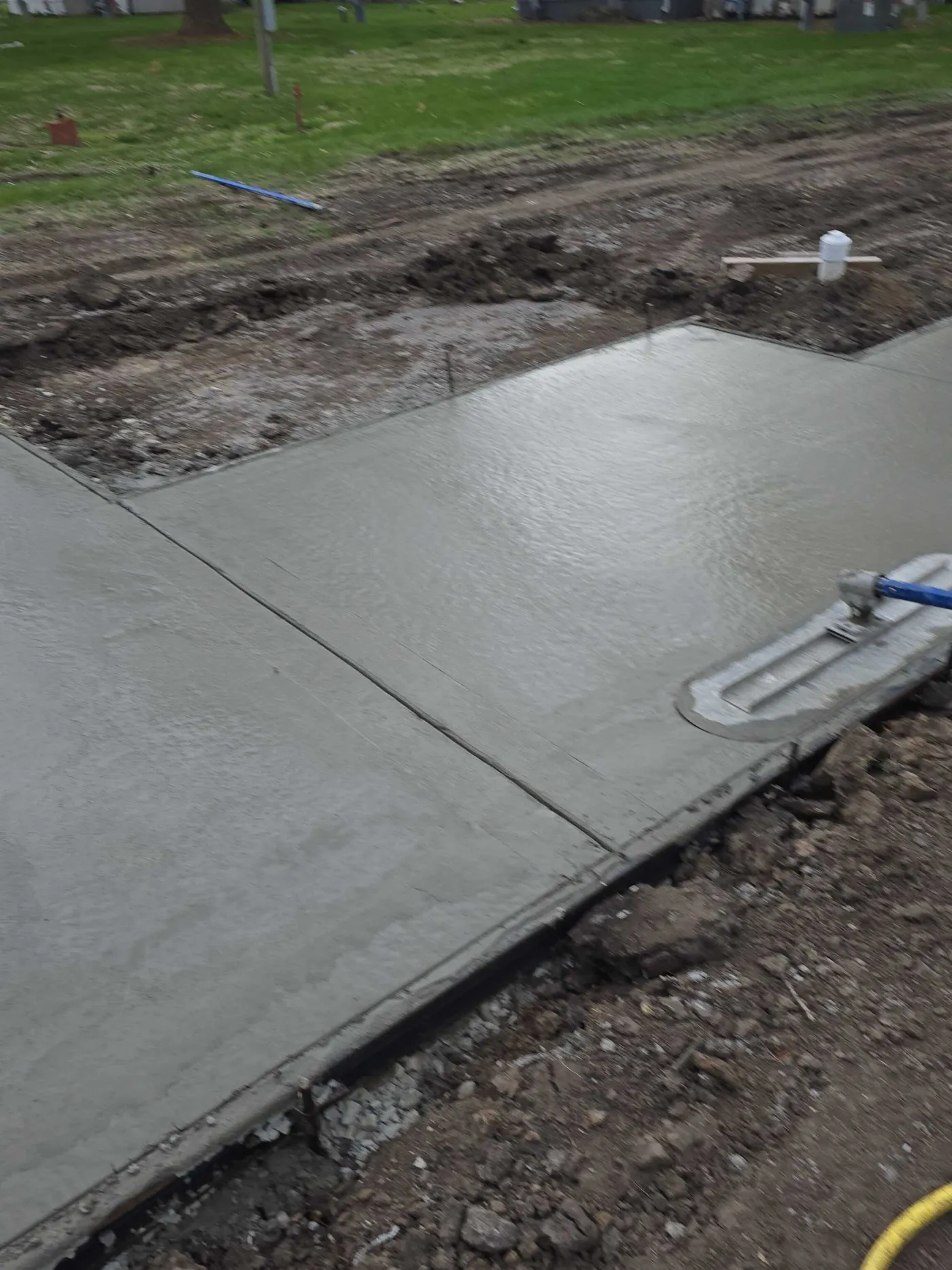
Concrete or asphalt: which driveway should you pour in Montana?
Both hold up here. Asphalt costs less to install and flexes with frost movement, but it wants maintenance every few years. Concrete costs more and lasts about twice as long, and once it cures it asks almost nothing of you. The right answer usually comes down to budget and how long you plan to own the place.
We pour concrete driveways and pave asphalt driveways, so there is no reason to steer you toward one. The difference shows up in how each behaves in Billings, where NOAA’s engineering weather data records an average of 81 freeze-thaw cycles a year at the airport across a 30 year record.
Concrete vs asphalt at a glance
| Factor | Asphalt | Concrete |
|---|---|---|
| Installed cost per sq ft | $6–$12 | $8–$12 and up |
| Typical lifespan | 15–20 years | 30–40 years |
| Maintenance | Crack seal, seal coat every 3–5 years | Little required, sealer optional |
| Handles ground movement | Flexes with it | Cracks along joints |
| Main weakness in cold | Water in cracks, then freeze-thaw | Surface scaling from deicers |
| Main weakness in heat | Softens and can deform | Holds up |
| Repairs | Cheap, blend in reasonably well | Usually means replacing a panel |
| Ready for traffic | A day or two | About a week |
What does each one cost?
Asphalt runs roughly $6 to $12 per square foot installed in 2026 guides. Plain concrete runs $8 to $12 and climbs from there with any finish beyond broom. On a 600 square foot driveway that is about $3,600 to $7,200 for asphalt against $4,800 to $7,200 for concrete.
The gap is real but narrower than most people expect on plain work. Where it widens is decorative concrete. Colored or exposed aggregate pushes concrete to $8 to $12 per square foot, and stamped work runs $12 to $18, which asphalt has no equivalent for. It also widens on jobs with heavy base repair, since concrete generally wants more of it.
Run the numbers over time and the ranking flips. Two asphalt driveways in 40 years, plus seal coating every few years, costs more than one concrete driveway that mostly gets left alone. Whether that matters depends on whether you expect to be there for it. Our concrete driveway cost breakdown and asphalt driveway cost breakdown have the size tables for both.
How long does each one last here?
Industry sources put asphalt driveways at 15 to 20 years and concrete at 30 to 40. Those numbers assume the base was built right and the surface got the maintenance it asks for. Neither material reaches its number sitting on soft, poorly compacted ground.
Maintenance moves the asphalt figure more than anything else. Sealed cracks keep water out of the base, and water in the base is what kills asphalt in this climate. The federal highway administration credits crack and fog seals with extending pavement life by one to four years, and research from the national center for asphalt technology found sealing on pavement still in good condition lasted more than seven and a half years before failure, against under five for crack filling.
Concrete’s number is less sensitive to what you do, and more sensitive to what got poured. Air-entrained mix at 4,000 psi with control joints cut at reasonable spacing lasts decades. Under-aired concrete, troweled too slick, salted its first winter, starts flaking within a few years and no amount of care brings it back.
Which one handles Montana freeze-thaw better?
Asphalt is more forgiving of movement. The mat flexes as the ground swells and settles, so frost heave shows up as cracking that can be sealed rather than as a broken slab. That is a real advantage, and even concrete trade associations acknowledge it.
Concrete handles freezing and thawing fine when it is specified for it. The national ready-mixed concrete association recommends 4,000 psi and about 6 percent entrained air for exterior slabs. Those microscopic air bubbles give freezing water somewhere to expand instead of blowing the top layer off. Without them, the surface scales.
The two materials just fail differently. Asphalt fails from the outside in: a crack lets water reach the base, the base softens, and the surface caves. Concrete fails from the top down: deicing chemicals push more water into the surface and drive more freeze cycles through it, and the top layer peels.
Summer reverses the comparison. Asphalt softens in heat and can deform under a trailer jack or a hot day of parking in one spot. Concrete does not care. Billings gets both ends of that, so neither is a free pass.
What does each one ask of you afterward?
| Task | Asphalt | Concrete |
|---|---|---|
| First treatment after install | Wait for cure, then seal coat | Sealer around 30 days, optional |
| Crack sealing | As soon as cracks appear | Not applicable, joints do the work |
| Seal coating | Every 3–5 years | Optional, every couple of years |
| Deicer rules | No restriction | None the first winter, moderate after |
| Typical annual attention | Walk it each spring | Rinse off tracked-in salt |
The cure rule catches people out. New asphalt cannot be sealed right away. The Colorado Asphalt Pavement Association calls for 30 to 90 days of 70 degree daytime temperatures between paving and the first seal coat, and gives a simple water test to confirm the mat is ready. In Montana, a driveway paved in September will not see that many warm days until the following summer.
On the concrete side, the rule that matters most is about the first winter. Skip the ice melt entirely and use clean sand for traction. After that, use deicers sparingly, and stay away from ammonium sulfate, ammonium nitrate and magnesium-based products at any age. Those are chemically aggressive and take concrete surfaces apart.
Which is easier to plow?
Surface condition decides this more than material does, and there is not much published research comparing the two for snow removal. One consumer comparison notes that ice releases more easily from asphalt. Beyond that, most of what gets said about plowing is opinion rather than data.
What we see in the field is simpler. Blades catch edges. A heaved concrete panel or a settled asphalt patch gives the plow something to grab, and that is a base problem on either surface. A flat drive with tight joints and no lifted edges plows fine whether it is black or gray.
The one real difference is repair. A blade that gouges asphalt leaves a scar you can patch and seal. A blade that chips a concrete edge leaves a chip. Neither is a reason to pick one over the other, but it is worth knowing before you hand a plow contract to whoever is cheapest.
What happens when it fails?
Asphalt fails gradually and repairs cheaply. Cracks get sealed, potholes get cut out and patched, and eventually a worn surface gets an overlay at $3 to $8 per square foot. You can keep an asphalt drive going a long time on small annual spending, which suits people who would rather budget in pieces.
Concrete is the opposite shape. It goes a long time with no attention, then needs real work. There is no overlay for a cracked slab. A failed panel comes out and gets repoured, and a failed driveway becomes a removal and replacement job. Lifting a sunken slab is a different trade and it does not repair concrete that is cracked or flaking, so when a slab is done, replacement is the fix.
So which should you pour?
Pick asphalt if the budget is tight now, if the drive is long, if the ground moves, or if you would rather spend a little every few years than a lot once. Rural drives around Shepherd, Huntley and Lockwood usually come out ahead in asphalt for exactly those reasons. We pave asphalt driveways and back them with crack sealing and seal coating.
Pick concrete if you are staying, if you want a surface that asks nothing of you, or if appearance is part of the point. A concrete driveway poured on a compacted base with proper air content and joints will outlive two asphalt drives, and it will still look like a driveway in year 25.
Both seasons are short. Montana DOT stops highway paving on November 1 and stops when the surface is under 35 degrees, and it calls anything below 35 degrees cold weather concreting. Whichever material you land on, the schedule fills from spring forward.
FAQ
Is concrete or asphalt better for a Montana driveway? Both work here when they are built right. Asphalt costs less up front, flexes with frost movement, and wants maintenance every few years. Concrete costs more, lasts roughly twice as long, and asks for very little once it cures. Your budget and how long you are staying decide it.
How much more does a concrete driveway cost than asphalt? Published 2026 guides put asphalt around $6 to $12 per square foot installed and concrete at $8 to $12 and up. On a 600 square foot drive that is roughly $3,600 to $7,200 for asphalt against $4,800 to $7,200 for plain concrete. The gap widens with decorative finishes.
Which lasts longer, concrete or asphalt? Concrete, by roughly double. Industry sources put asphalt driveways at 15 to 20 years and concrete at 30 to 40. Maintenance changes both numbers. An asphalt drive that never gets crack sealed can be finished well inside 15 years, and neglected concrete scales early.
Does asphalt handle freeze-thaw better than concrete? Asphalt is more forgiving of ground movement because the mat flexes instead of cracking. Concrete handles freeze-thaw fine when it is air-entrained and jointed properly. The failure mode differs: asphalt cracks and needs sealing, concrete surfaces scale if deicers hit them too early.
How often does an asphalt driveway need sealing? Industry sources point to every three to five years for seal coating, and crack sealing as soon as cracks appear. New asphalt has to cure first. The Colorado Asphalt Pavement Association calls for 30 to 90 days of 70 degree daytime temperatures before the first coat, which in Montana usually means the following summer.
Can you use ice melt on a new concrete driveway? Not the first winter. The national ready-mixed concrete association advises against deicing chemicals on new concrete and recommends clean sand for traction instead. After that, use them in moderation, and never use ammonium sulfate, ammonium nitrate or magnesium-based products on any concrete.
Which driveway is easier to plow? Surface condition matters more than material. A flat, well-jointed slab and a flat asphalt mat both plow cleanly. What catches a blade is a heaved edge or a lifted panel, which is a base problem on either surface. One published comparison notes ice releases more easily from asphalt.
Get both numbers before you decide
The cleanest way to settle this is to price your actual driveway both ways. Ostermiller Construction pours concrete driveways and paves asphalt driveways across Billings, Laurel, Lockwood and the Yellowstone Valley, so the comparison you get is for your site rather than an average one. Ask for a free estimate and we will measure it and quote both.
Want a number for your own project?
We look at the job in person and hand you a free written quote across Billings & the Yellowstone Valley.